Environmental Product Declaration (EPD)
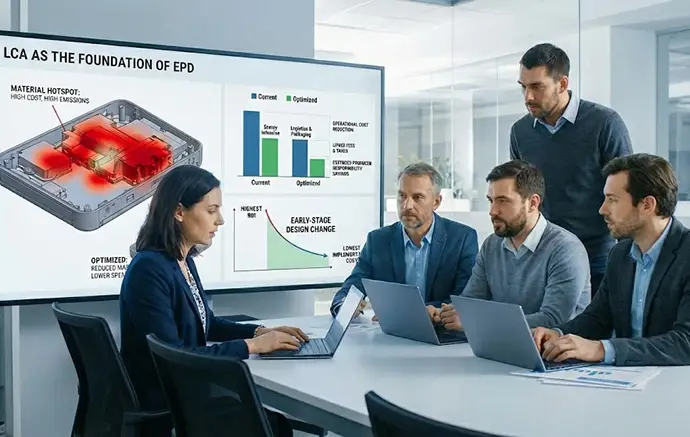
VerdaLynx uses Life Cycle Assessment (LCA) as the technical foundation for Environmental Product Declarations (EPDs), ensuring credible, verified, and regulation-aligned environmental transparency.
An Environmental Product Declaration is only as robust as the Life Cycle Assessment behind it. VerdaLynx treats LCA as the non-negotiable baseline for EPD development, fully aligned with ISO 14040/14044 and ISO 14025 standards.
Why LCA is the foundation of an EPD
EPDs require quantified, reproducible environmental impacts across defined life cycle stages.
LCA provides the calculation framework, system boundaries, data quality rules, and impact categories.
Without a compliant LCA model, an EPD cannot be verified or registered.
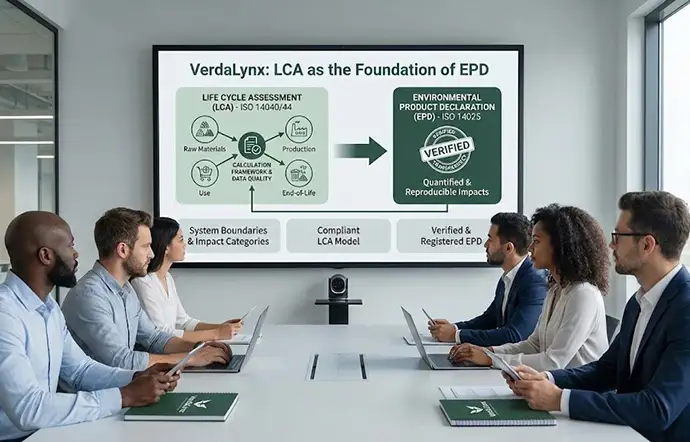
Verification and publication
Independent third-party verification is mandatory for credibility and market acceptance.
Verifiers assess methodological compliance, data quality, and PCR adherence.
Once approved, the EPD is registered with an EPD program operator and published.
VerdaLynx advantage
Integrates LCA, EPD logic, and documentation in one workflow.
Ensures consistency between EPDs, Digital Product Passports, and regulatory reporting.
Reduces time, cost, and rework while maintaining full technical rigor.
With VerdaLynx, EPDs are built on solid science, not approximations.
Core EPD generation process
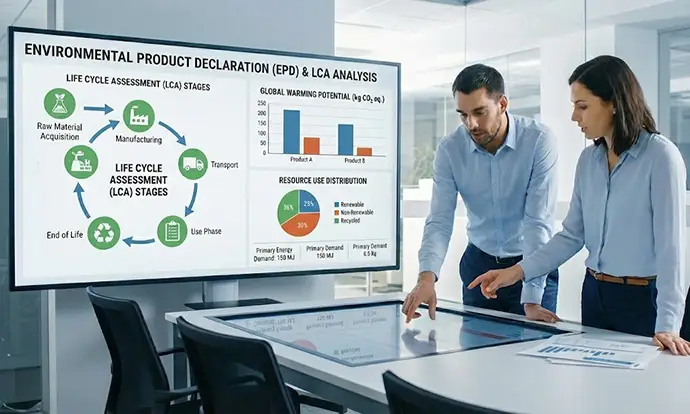
Goal and scope definition: Product category, functional unit, system boundaries, and assumptions aligned with the relevant Product Category Rules (PCR).
Life cycle inventory (LCI): Collection of primary production data and secondary background data.
Impact assessment (LCIA): Calculation of standardized environmental indicators (e.g. climate change, resource use, acidification).
Interpretation: Validation of results, sensitivity checks, and consistency review
Sustainability readiness & Risk assessment
Assess your Sustainability Maturity Level & Address your Sustainability-related Risks.
 English (UK)
  Slovenščina