Life-Cycle Assesment
VerdaLynx uses Life Cycle Assessment (LCA) to simultaneously reduce product environmental impact and improve financial performance by identifying inefficiencies across the entire value chain.
VerdaLynx positions LCA as a decision-making engine, not a reporting exercise. By quantifying environmental impacts from raw material extraction through production, distribution, use, and end-of-life, VerdaLynx enables companies to see where impact and cost are structurally linked.
How LCA improves environmental performance
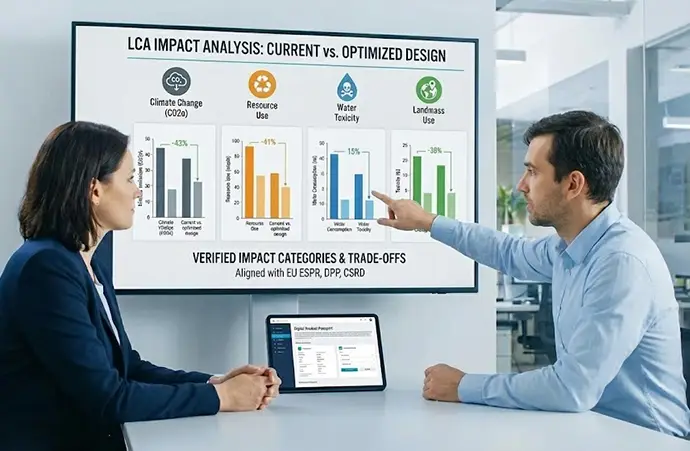
Identifies high-impact materials, processes, and suppliers using verified impact categories (climate change, resource use, water, toxicity).
Quantifies trade-offs between design options instead of relying on assumptions or marketing claims.
Supports measurable improvements aligned with EU requirements (ESPR, DPP, CSRD where applicable).
Why VerdaLynx is different
LCA results are embedded into product strategy, not isolated in sustainability reports.
Data structures are compatible with Digital Product Passports, enabling reuse across compliance and customer communication.
Scenario modeling supports evidence-based decisions before capital is committed.
With VerdaLynx, LCA becomes a tool for smarter products: lower impact, lower risk, and stronger margins—by design, not by compromise.
How the same analysis improves the bottom line
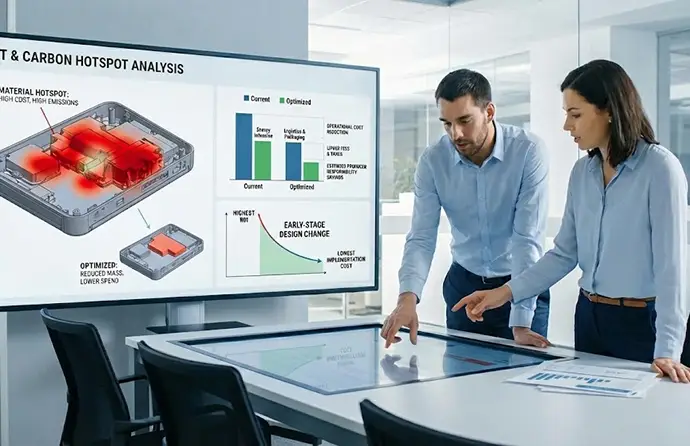
Material hotspots are often cost hotspots: reducing mass, complexity, or waste lowers both emissions and spend.
Energy-intensive processes revealed by LCA are direct targets for operational cost reduction.
Packaging, logistics, and end-of-life scenarios can be optimized for lower fees, taxes, and extended producer responsibility costs.
Early-stage design changes deliver the highest return on investment with the lowest implementation cost.

Sustainability readiness & Risk assessment
Assess your Sustainability Maturity Level & Address your Sustainability-related Risks.
 English (UK)
  Slovenščina